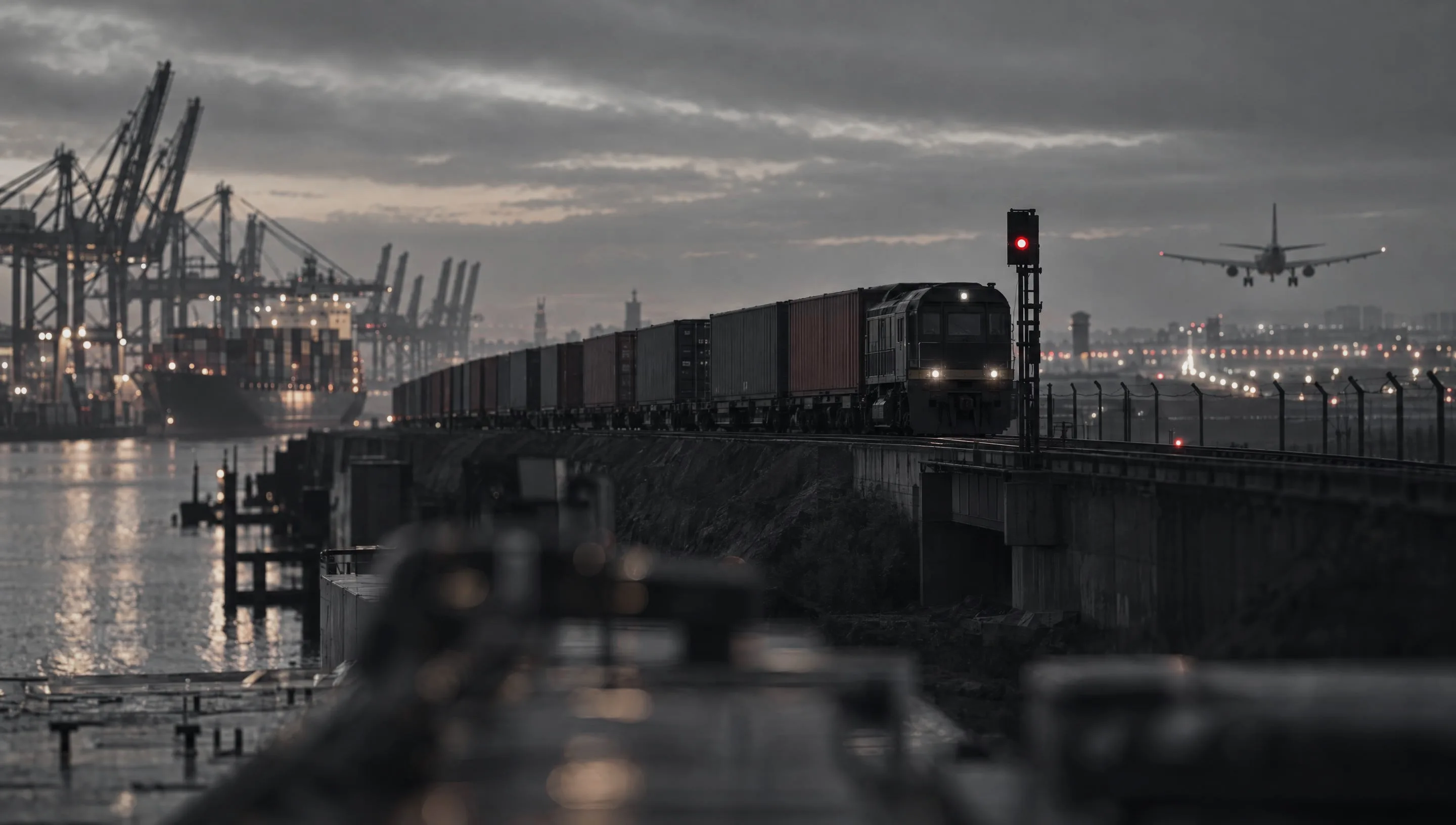
Rail, sea or air: when rail pays off
In short
Rail pays off when ocean freight is too slow and air freight too expensive. Beyond the freight rate, capital commitment, safety stock and the risk of stock-outs count. The higher the cargo value and the tighter the deadline, the more likely rail wins the overall comparison.
The freight rate is only part of the equation
Anyone comparing modes purely by price per container almost always picks ocean freight. Looking at total cost often leads to a different answer. Rail sits between sea and air in transit time and cost and closes that gap.
Three cost blocks that are often missing
- Capital commitment: goods in transit are paid for but cannot be sold. Every day in transit costs interest.
- Safety stock: longer and more variable transit times require bigger buffers in the warehouse.
- Stock-outs: when goods arrive late, production stoppages or lost sales cost money.
A simple back-of-the-envelope calculation
Take the cargo value of one container and your internal cost of capital. Multiply both by the number of days rail saves compared with ocean freight, divided by 365. The result is the capital commitment saved per container. The higher the cargo value, the bigger the effect.
| Factor | Favours rail | Favours sea |
|---|---|---|
| Cargo value | high | low |
| Deadline pressure | high | low |
| Predictability | regular volumes | large, flexible volumes |
| Replenishment | time-critical | not critical |
And air freight?
Air remains the fastest option for very urgent or very light, high-value shipments. For containers and series traffic, rail is often the more cost-effective alternative, with significantly lower emissions.
Our recommendation
Build rail into your modal mix as a fixed component rather than using it only in a bottleneck. You benefit from plannable departures and have an alternative when conditions change. More on the product: China–Europe Rail.
Expert-reviewed: 26 August 2026
Glossary
- FCL A full container booked exclusively for one shipment, regardless of how full it is.
- Northern corridor Rail corridor from China via Kazakhstan, Russia and Belarus to Poland, with gauge change in Małaszewicze.
- OCR Ocean service between Japan, China and Europe with weekly sailings.
- PAX Ocean service between Asia and Europe with sailings every 14 days, European leg via the Cape of Good Hope.