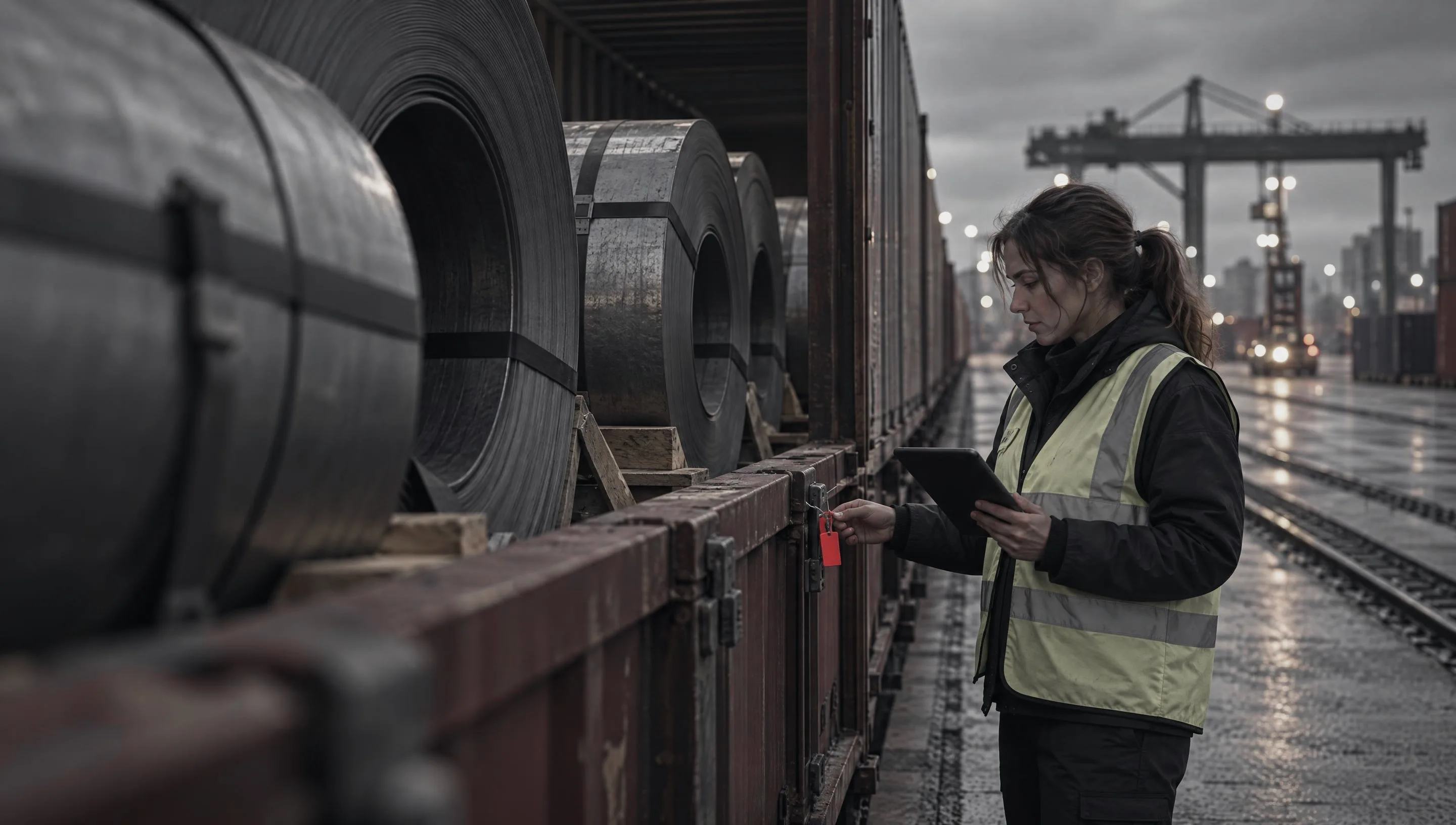
CBAM from 2027: what forwarders should prepare for steel and aluminium imports from China
In short
The EU CBAM has been in its definitive period since 1 January 2026: importers bringing in more than 50 tonnes of CBAM goods a year need authorised CBAM declarant status. 2027 is when it becomes tangible, with certificate sales starting on 1 February and the first annual declaration for 2026, together with the certificates, due by 30 September 2027. Forwarders should now clarify who acts as declarant for each shipment and which producer data travel with it.
What CBAM is and who it affects
CBAM stands for Carbon Border Adjustment Mechanism. Its legal basis is Regulation (EU) 2023/956, simplified by Regulation (EU) 2025/2083 in October 2025. CBAM puts a carbon price on imports of certain emission-intensive goods, based on the EU Emissions Trading System (EU ETS). The aim is that imported goods carry a carbon price comparable to that paid on goods produced in the EU.
Six sectors are covered: iron and steel, aluminium, cement, fertilisers, electricity and hydrogen. Three principles are worth keeping in mind:
- The obligations sit with the importer or the authorised CBAM declarant, not with the carrier.
- The mode of transport is irrelevant. Steel moving by rail is subject to the same rules as steel moving by sea.
- What counts is the emissions from production. Embedded emissions are the greenhouse gases released when the goods were made.
This article covers the EU CBAM. The United Kingdom is introducing its own CBAM on 1 January 2027, with separate rules for registration and payment administered by HMRC.
CBAM at a glance
| Item | Rule |
|---|---|
| Legal basis | Regulation (EU) 2023/956, amended by Regulation (EU) 2025/2083 |
| Sectors | Iron and steel, aluminium, cement, fertilisers, electricity, hydrogen |
| Threshold | 50 tonnes net mass per importer and calendar year, excluding electricity and hydrogen |
| Status | Above the threshold, only authorised CBAM declarants may import |
| One certificate | Corresponds to one tonne of CO₂ equivalent of embedded emissions |
| Certificate sales | From 1 February 2027 via a common central platform |
| Holding from 2027 | At each quarter end, at least 50 % of embedded emissions since the start of the year |
| Declaration and surrender | By 30 September of the following year, first in 2027 for 2026 |
| Repurchase | Request by 31 October; certificates bought for 2026 are otherwise cancelled on 1 November 2027 |
| Competent authority | Germany: German Emissions Trading Authority (DEHSt); Austria: Customs Office Austria |
Which steel and aluminium goods are in scope
For steel and aluminium, CBAM covers most of Chapter 72 of the Combined Nomenclature, numerous headings in Chapter 73 such as tubes, structures, containers, screws and nuts, and unwrought aluminium together with many aluminium products in Chapter 76. Annex I to the regulation, as amended, is the reference. Goods do not fall outside CBAM because they look processed; the CN code in the customs declaration is what decides.
For iron and steel and for aluminium, Annex II to the regulation currently limits the calculation to direct emissions from production, so emissions from purchased electricity are not included. The Commission intends to report on whether indirect emissions should be added for these sectors. For complex goods, the embedded emissions of precursors count as well, such as the crude steel from which a tube was made. That is why the emissions data also covers the installations where precursors were produced.
In practice, check the CN code of every steel and aluminium consignment against Annex I before booking. For machine parts and assemblies, also keep an eye on the planned extension from 2028 described below.
The CBAM timeline for 2026 and 2027
The definitive period has applied since 1 January 2026. 2027 is the year in which declarants pay and declare for the first time. The key dates:
CBAM deadlines up to 2028
Transitional period begins
Quarterly reports without certificates, until the end of 2025.
Definitive period
Imports above the 50-tonne threshold only by authorised CBAM declarants.
Application deadline
Applicants by this date could keep importing until a decision was taken.
Certificate sales begin
Via the common central platform of the member states.
First quarter end with minimum holding
Certificates for at least 50 % of embedded emissions since the start of the year.
First CBAM declaration
Declaration for 2026 imports and surrender of certificates.
Repurchase request
Last day to request repurchase of excess certificates for 2026.
Cancellation
Certificates bought for 2026 and not surrendered lapse without compensation.
Downstream products (proposed)
Extension to around 180 steel and aluminium products, not yet adopted.
For forwarders, the period from February 2027 onwards matters most. That is when authorised declarants buy certificates for the first time: retrospectively for 2026 imports, and on a rolling quarterly basis for 2027 imports.
The 50-tonne threshold
Since 2026, a mass-based threshold has replaced the former value limit per consignment. An importer bringing in no more than 50 tonnes net mass of CBAM goods in a calendar year is exempt from CBAM obligations. The quantity is aggregated per importer across iron and steel, aluminium, fertilisers and cement; electricity and hydrogen do not count towards it.
Once the threshold is exceeded, all imports of that year fall under CBAM, including the first 50 tonnes. Exceeding it without authorisation can lead to penalties of three to five times the standard penalty for each certificate that should have been surrendered. The Commission monitors import volumes using customs data and shares a list of importers above 90 % of the threshold with the authorities via the CBAM registry. Splitting imports artificially to stay below the threshold is expressly classed as circumvention.
An importer that crosses the threshold during the year has to reach the required certificate holding by the end of the following quarter. For forwarders, the practical question is not the size of a single consignment but the annual volume of the importer across all modes and all customs representatives. A customer sourcing steel partly by rail and partly by sea can exceed the threshold even though no individual shipment is large.
Who does what: importer, customs representative, forwarder
The most important question before the first customs clearance is how the roles are split. Since the 2025 simplification, Article 5 of the regulation spells this out:
Roles for CBAM goods
| Importer with own authorisation | Indirect customs representative acting as declarant | Forwarder handling transport only | |
|---|---|---|---|
| Authorisation | Apply before the threshold is expected to be exceeded | Always required before importing CBAM goods, regardless of the threshold | No CBAM authorisation needed for transport |
| CBAM declaration | Files it, or has it filed in its name | Files it for represented importers above the threshold | No declaration of its own |
| Certificates | Buys and surrenders them | Buys and surrenders them for those imports | None |
| Responsibility | Stays with the importer, even when a third party files | Lies with the representative as far as it acts as declarant | For the transport and passing on data in time |
In more detail:
- Importer: an importer established in the EU applies for authorisation itself before it expects to exceed the threshold. It may delegate the filing of declarations to a person acting in its name, but it remains responsible.
- Indirect customs representative: anyone declaring CBAM goods as an indirect customs representative needs authorised CBAM declarant status under Article 5 of the regulation. It acts as declarant where the importer appoints it on that basis and it agrees. It then carries the declaration, the certificates and the liability for those imports. An importer not established in the EU cannot become a declarant itself, so the indirect customs representative has to step in.
- Forwarder handling transport: a company organising only the transport has no CBAM obligations. It does, however, make sure that CN code, origin and producer data reach the declarant in time.
CBAM certificates from 2027: purchase, price and surrender
- Purchase: authorised declarants buy certificates from 1 February 2027 via a common central platform run on behalf of the member states.
- Price: for 2026 imports, the quarterly average of EU ETS auction prices applies. From 2027, the price follows the weekly average.
- Holding: from 2027, at the end of each quarter the account must hold certificates covering at least half of the embedded emissions of goods imported since the start of the year, adjusted for free allocation. The basis is either the default values without mark-up or the number surrendered for the previous year, where goods and origin are unchanged.
- Surrender: by 30 September of the following year, declarants submit the CBAM declaration and surrender the certificates, for the first time in 2027 for 2026 imports.
- Repurchase and cancellation: on request by 31 October, the Commission buys back excess certificates within limits. Certificates bought for 2026 can only be repurchased in 2027, and any left over are cancelled without compensation on 1 November 2027. Certificates bought later lapse on 1 November of the year after next.
- Deduction: a carbon price actually paid in the country of origin can be deducted.
The number of certificates to surrender follows from the embedded emissions, less any carbon price paid in a third country and adjusted for the free allocation that EU producers still receive under the EU ETS. Under current law this free allocation is phased out gradually until 2034, so the burden rises accordingly. In July 2026 the Commission proposed stretching that path. This has not been adopted.
Embedded emissions: actual or default values
There are two ways to determine embedded emissions for the declaration:
- Actual values: the producer determines the real emissions of its installation using the methods set out in the regulation. These values must be verified by an accredited verifier, and the verification report forms part of the declaration.
- Default values: where verified actual values are missing, default values set by the Commission per CN code and country of origin apply. They include a mark-up. Where reliable data for a country are lacking, they are based on the average emission intensity of the ten highest-emitting exporting countries.
Actual values can therefore lead to fewer certificates, but they depend on data that only the producer in China can supply. Operators in third countries can register their installations in the CBAM registry and must also provide information on controlling entities.
The declarant should request the following from the supplier for each delivery:
- Identification and location of the installation where the goods were made
- Production route and specific embedded emissions per tonne
- Precursors, with the installation they came from and their emissions
- Any carbon price paid in the country of origin, with evidence
- For actual values, the report of the accredited verifier
Collect this data close to the shipment. A year later, when the declaration is due, contacts at the supplier are often harder to reach.
What the rail route from China means for CBAM
- Timing: the CBAM obligation arises on release for free circulation. A container that continues under transit from the EU border becomes relevant only at the customs office of destination. The annual volume is based on the year of import, not the departure date in China.
- Turn of the year: a container leaving Yiwu on 20 December 2026 reaches Duisburg, on paper, between 3 and 5 January 2027 at 14–16 days for the main leg. If it is cleared there or later, it counts towards the 2027 volume, not 2026.
- Groupage containers: where one container carries goods for several importers, for example as a part load, each part consignment counts towards the annual volume of its own importer. What matters is the importer and the customs declaration, not the container.
- Customs declaration: authorised declarants enter their CBAM account number and the relevant document code in the customs declaration. Under the TARIC document codes, Y128 is reserved for authorised declarants and Y238 applies to businesses with an application number but no authorisation yet.
- Emissions data: the declarant needs producer data for the annual declaration, not for customs clearance. Collect it per consignment anyway, while the supplier is still reachable. Without verified actual values, default values apply.
- Use the transit time: for rail freight from China to Europe, our route data lists 14–16 days terminal to terminal as an indicative value on many routes. That is enough time to settle status, codes and producer data before arrival.
Our article What happens in Małaszewicze explains the border crossing into the EU.
From booking to CBAM declaration
For every consignment of CBAM goods, the process runs in seven steps. The first four belong before or at customs clearance, the last three in the following year:
From booking to CBAM declaration
Check the CN code
Compare it with Annex I to the regulation before booking.
Clarify role and status
Who is the declarant, is there an authorisation or application number, what is the annual volume?
Request producer data
Installation, production route, embedded emissions, with a verification report for actual values.
Customs declaration
Enter the CBAM account number and the correct document code.
Hold the quarterly balance
From 2027, cover at least 50 % of embedded emissions at each quarter end.
Declare and surrender
By 30 September of the following year in the CBAM registry.
Check repurchase
Request repurchase of excess certificates by 31 October, otherwise they lapse.
For forwarders, steps one to four are where they make the difference. Anything missed at this stage is hard to recover in the following year.
Authorisation: what the authority checks
Applications for authorised CBAM declarant status are filed electronically in the CBAM registry. Under Implementing Regulation (EU) 2025/486, the competent authority checks, among other things:
- whether the applicant or responsible persons have committed serious or repeated infringements of customs, tax or market abuse law in recent years,
- whether the applicant has the financial standing to meet its obligations,
- whether its organisation and internal controls are adequate for the expected number of certificates.
The application also states the estimated import quantities for the current and the following year and, where available, the number of the AEO certificate. Businesses that have not been continuously established during the two financial years before the application must provide a guarantee. Indirect customs representatives also list the importers they represent.
The competent authority in Germany is the German Emissions Trading Authority (DEHSt) and in Austria Customs Office Austria with its Office for National Emissions Trading. This article does not constitute legal advice; the regulation and the guidance of the competent authority are decisive.
Checklist for forwarders
- Identify CBAM goods: check the CN code against Annex I before the consignment is booked.
- Clarify the role: is the importer an authorised declarant, or are you taking on that role as indirect customs representative? In that case you carry the declaration, the certificates and the liability.
- Check the status: ask for the authorisation or application number and compare the annual volume with the 50-tonne threshold.
- Prepare the customs declaration: enter the CBAM account number and the document code correctly. Only one code should be used per commodity code.
- Request producer data: installation, production route and embedded emissions, with a report from an accredited verifier for actual values.
- Document origin: where origin is in doubt, customs decides.
- Diarise the deadlines: 1 February 2027, the 2027 quarter ends, 30 September 2027, 31 October 2027 and 1 November 2027.
Points one to four are settled before the goods arrive. For rail consignments from China, the main-leg transit time is available for this, provided the questions are asked at booking rather than at customs clearance.
Prepare the first declaration for 2026 now
The first CBAM declaration in September 2027 covers imports that have largely already taken place. For forwarders that cleared CBAM goods in 2026, this creates a concrete task: their customers need a complete overview of those imports, and part of the data sits with the forwarder.
A list per importer with the following details helps:
- Date and number of the customs declaration
- CN code and description of goods
- Net mass in tonnes
- Country of origin and, where known, the producing plant
- Document code used and CBAM account number
With this overview, the importer can check whether it exceeded the 50-tonne threshold in 2026 and request the missing emissions data from its suppliers in a targeted way. The earlier this happens, the better the chance of using actual rather than default values.
This is also the moment to agree how you will work together in 2027. Who reports new suppliers, who monitors the annual volume, and who receives the producer data when it arrives with the shipment? Who bears the cost of certificates commercially is a matter for the contract between importer and supplier. Nothing changes for the transport itself, but the data flows do.
Outlook: downstream products from 2028
In December 2025 the Commission proposed extending CBAM from 1 January 2028 to around 180 downstream products with a high steel or aluminium content, mainly industrial goods and components for machinery. Anti-circumvention rules would be added. The European Parliament adopted its negotiating position in September 2026; the amendment has not yet been adopted (as of November 2026). For machine parts and assemblies made of steel or aluminium, it is worth checking whether they could be affected in future.
Keeping transport and CBAM apart
As a transport provider, we organise the rail transport. CBAM obligations remain with the importer or the authorised declarant. For smooth handling, include the following in your request:
- CN code and description of goods
- Country of origin and producing plant, where known
- Customs office of destination and the intended procedure at the EU border
- Who lodges the customs declaration and who is the CBAM declarant
More on the product: China-Europe rail freight. Transit times by route are listed in our transit time overview, and our article Rail, sea or air shows when rail pays off against sea and air.
Expert-reviewed: 26 November 2026