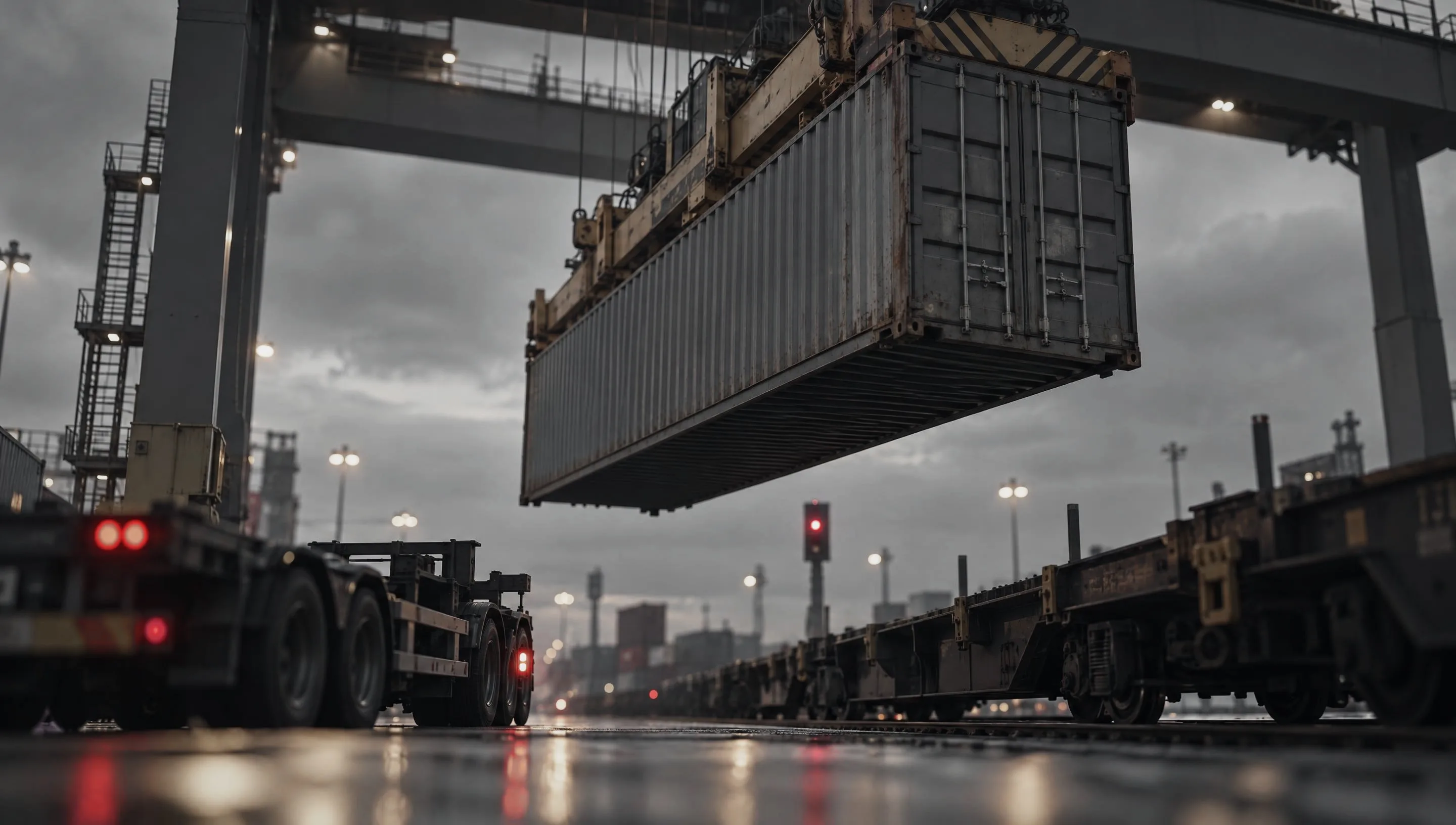
Intermodal vs multimodal transport: how containers switch between road and rail
In short
Multimodal transport simply means carriage by two or more modes, while intermodal transport keeps the goods in the same loading unit throughout. Combined transport is intermodal transport with the main leg by rail, inland waterway or sea and short road legs at each end, with a crane or reach stacker lifting the container from truck to wagon at the terminal. Whether it pays off depends on terminal proximity, departure frequency, loading unit and time windows.
Intermodal vs multimodal transport: the definitions
The terms are often used interchangeably. For quotations, contracts and funding questions, the difference matters. The joint terminology published by UNECE, the European Conference of Ministers of Transport and the European Commission draws the line as follows:
Multimodal, intermodal, combined
| Multimodal transport | Intermodal transport | Combined transport | |
|---|---|---|---|
| Definition | Carriage of goods by two or more modes of transport | Movement of goods in one and the same loading unit or road vehicle across two or more modes | Intermodal transport with the main leg by rail, inland waterway or sea |
| Loading unit | Any, goods may be reloaded | Stays the same, only the unit is transshipped | Stays the same, only the unit is transshipped |
| Goods handled en route | Possible | No | No |
| Role of road | Not specified | Not specified | First and last legs only, kept as short as possible |
| How it fits | Umbrella term | A subset of multimodal transport | A specific form of intermodal transport |
Combined transport is therefore a specific form of intermodal transport. A container travels by truck to the terminal, by rail on the main leg and by truck again to the consignee. Nobody touches the cargo on the way: only the mode changes, not the loading unit.
The reverse does not hold. Not every multimodal movement is intermodal. If goods are taken out of a container at a port and loaded loose onto a lorry, two modes are involved, but the loading unit changes. For forwarders the distinction has practical weight, because every time the goods themselves are handled there is an extra step and an extra risk of damage.
"Multimodal" also has a contractual meaning: carriage by different modes under a single contract of carriage. German law, for example, covers this in section 452 of the Commercial Code (HGB). For forwarders it matters because liability and the applicable law depend on whether one through contract or separate contracts per leg are in place. The section on liability below goes into this.
How a container moves between road and rail
In unaccompanied combined transport, the standard for containers, a shipment runs through six steps:
From truck to train and back
Booking
A slot on a train with origin and destination terminal, container type, gross weight and dangerous goods details.
Pre-carriage
A truck delivers the loaded container to the departure terminal before the cut-off.
Gate-in
The terminal checks unit, seal, documents and weight and records visible damage.
Transshipment
A gantry crane or reach stacker lifts the container from the truck onto the wagon.
Main leg
The train runs to the destination terminal; at borders the locomotive or crew sometimes changes.
On-carriage
Unloading, release, truck to the consignee, then the empty goes to a depot or its next load.
What matters at each step:
- Booking: you book a slot on a train, stating origin and destination terminal, container type, gross weight and any dangerous goods details. The more precise the details, the more reliably the container fits the planned wagon.
- Pre-carriage: a truck collects the loaded container from the shipper and delivers it to the departure terminal. What counts is the cut-off for the booked train, not its departure time.
- Gate-in: the terminal checks the unit, seal, documents and weight and records any visible damage. This record later serves as evidence of the condition in which the container was handed over.
- Transshipment: a gantry crane or reach stacker lifts the container from the truck onto the wagon. The train is made up according to a loading plan that takes account of weights, lengths and wagon types.
- Main leg: the train runs to the destination terminal. On cross-border services, the locomotive or crew sometimes changes at the border.
- On-carriage: at the destination terminal the container is unloaded and made available for collection. A truck takes it to the consignee, and the empty then returns to a depot or moves on to its next load.
In accompanied combined transport, by contrast, the complete lorry travels on the train with its driver, as on a rolling motorway. For container traffic this form plays hardly any role, because tractor unit and driver travel the whole distance and the loading unit is never separated from the vehicle.
Which loading units can go by rail
| Loading unit | Handling | Planning note |
|---|---|---|
| ISO container 20, 40 and 45 ft, including high cube | Crane or reach stacker | Standardised worldwide and stackable, the norm in Eurasian traffic |
| Swap body | Crane or reach stacker with grappler arms | Needs grappler pockets and a codification |
| Craneable semi-trailer | Crane or reach stacker with grappler arms | Needs reinforced grappler pockets and a codification |
| Non-craneable semi-trailer | Special handling technology | Only at terminals and on wagons with matching equipment |
For rail, swap bodies, semi-trailers and non-ISO containers carry a yellow codification plate under the UIC specification IRS 50596-6. Overseas ISO containers do not need a codification. The code shows which wagons and lines the unit may use, given its profile: a unit may only run on a line if its profile code does not exceed the profile of that line. Under DIN EN 13044, the owner is no longer shown on the yellow plate but identified by the ILU code, a separate owner key for intermodal loading units.
Before booking, check that loading unit, wagon and line match. For containers this is usually straightforward; for swap bodies and trailers the codification belongs in the request.
Which wagons carry containers
Containers travel on container wagons. Common types are four-axle wagons with a loading length of 60 or 80 ft and six-axle articulated wagons with two platforms for one 40 ft container each. The combinations of 20, 40 and 45 ft containers a wagon can take are set by its loading scheme. Depending on the design, a wagon with 80 ft of loading length can, for example, carry two 40 ft containers or combine 20 and 40 ft units.
For your planning, weight is what matters most. The permitted load per wagon and per loading position limits how heavy the containers on a wagon may be, so depending on wagon and weight, not every combination that fits by length is actually possible. Declare heavy units at booking so that the loading plan can take them into account. Our page on locomotives and wagons covers locomotives and container wagons for European intermodal services.
At the terminal: where time is won or lost
The terminal is the interface between road and rail. Handling is done by gantry cranes spanning several tracks and lanes, or by reach stackers working flexibly across the yard. Containers are lifted by a spreader at their corner fittings, swap bodies and craneable trailers by grappler arms at their grappler pockets. Four points decide whether the handover runs smoothly:
- Cut-off: miss it and the container goes on the next train. With only a few departures a week, that costs days.
- Collection window: after arrival, a container stands free of charge at the terminal for a limited time only. After that, storage charges apply, depending on the terminal and the agreement.
- Weight and load securing: the gross weight must be declared correctly. Cargo inside the container must be secured for the forces of rail operation, not only for the road. A useful reference is the CTU Code of IMO, ILO and UNECE, a non-mandatory code of practice for packing cargo transport units across the whole intermodal chain.
- Empty containers: provision and return of empties belong in the plan, especially with one-way use.
One point is often underestimated: both road legs are tied to fixed windows. The pre-carriage truck has to reach the terminal before the cut-off, and the on-carriage truck has to collect within the collection window. Aligning both windows with loading times at shipper and consignee avoids waiting on either side. Empty moves come on top: for exports, the truck collects the empty container from the depot before loading; for imports, it takes the empty back after unloading. Both trips belong in the schedule and in the cost of the road share.
The legal framework: Directive 92/106/EEC
At EU level, Directive 92/106/EEC defines combined transport between member states, and national incentives build on it. The main rules at a glance, using Germany and Austria as examples:
| Rule | Value | Basis |
|---|---|---|
| Units covered | Lorries, trailers, semi-trailers with or without tractor unit, swap bodies, containers of 20 ft or more | Directive 92/106/EEC |
| Rail, inland waterway or sea section | More than 100 km as the crow flies | Directive 92/106/EEC |
| Road leg for rail | To or from the nearest suitable rail terminal | Directive 92/106/EEC |
| Road leg for inland and sea ports | Within a radius of no more than 150 km as the crow flies | Directive 92/106/EEC |
| Gross weight in Germany | 44 t instead of 40 t for certain articulated vehicles carrying containers or swap bodies of up to 45 ft on road legs | Section 34(6) StVZO |
| Sunday and holiday driving ban in Germany | Exemption for trips of up to 200 km to or from the nearest suitable rail terminal | Section 30(3) StVO |
| Vehicle tax in Germany | Exemption possible for vehicles used exclusively for road legs and identifiable as such | Section 3 no. 9 KraftStG |
| Gross weight in Austria | 44 t on road legs to and from the nearest technically suitable rail terminal | Section 4(7a) KFG 1967 |
The European Commission proposed a revision of the directive in November 2023. As of November 2026 it has not been adopted. The Commission's 2026 work programme announced that the proposal would be withdrawn, but it has not been formally withdrawn so far. The existing Directive 92/106/EEC remains the reference.
Whether a specific journey qualifies needs to be checked case by case. In practice it has to be possible to show that a road leg forms part of a combined transport operation, so keep the booking and terminal documents for each journey to hand.
Liability and contract: what forwarders should watch
If a forwarder takes on a door-to-door movement by road and rail as carrier or at a fixed price, and so under a single contract for the whole distance, German law applies its rules on multimodal carriage. Other jurisdictions have their own rules, so the German approach serves as an example here:
- Single contract: section 452 HGB covers carriage by different means of transport under a single contract of carriage, where the legs would be subject to different legal rules if they had been contracted separately. In principle the general freight rules of the HGB then apply, unless applicable international conventions provide otherwise.
- Known place of loss: if it is established that loss or damage occurred on a particular leg, section 452a HGB applies the rules that would govern a contract for that leg. The party relying on this has to prove where the damage occurred.
- Separate contracts: where pre-carriage, main leg and on-carriage are contracted individually, each leg is governed by its own contract and its own liability rules.
In practice, the handover records at the terminal are more than operating paperwork. They show the condition in which the container entered each leg and so help to narrow down where damage occurred. This section does not constitute legal advice; the specific contract and the applicable law are decisive.
Dangerous goods in combined transport
Dangerous goods can move in combined transport, but they need extra planning. ADR applies on the road and RID on the railway. In combined transport each leg has to comply with the rules of its mode, from the marking of the loading unit to the accompanying documents. State UN number, class and quantity at booking. Terminals and trains may have their own rules on accepting, storing and positioning dangerous goods, and these belong in the planning of cut-off and collection.
Strengths and limits of combined transport
Combined transport is no cure-all, but for many container flows it is a solid solution. A sober assessment helps with the decision.
What speaks for it:
- Higher permitted gross weight on the road legs, for example in Germany and Austria
- Exemptions from the Sunday and holiday driving ban for trips to and from the terminal in Germany
- Predictable departures on the main axes, for single containers too
- Fewer lorry kilometres on the long haul and so less reliance on drivers for long trips
- A direct link to Eurasian rail services without changing the loading unit
Where it reaches its limits:
- Two extra transshipments that take time and have to be documented carefully
- Fixed cut-offs and departure times instead of the flexible departure of a lorry
- Dependence on terminal opening hours and capacity
- Disruption on the rail network affects connections and collection windows
- On short distances, handling and the road share often outweigh the advantage of rail
What matters is how well the chain is planned. The earlier terminal, train, pre-carriage and on-carriage are aligned, the more the advantages count.
When combined transport suits your shipment
Combined transport adds two transshipments to the chain. It pays off when the rail main leg outweighs these interfaces. Check these criteria:
- Length of the main leg: the larger the rail share relative to the road legs, the more the switch makes sense.
- Terminal proximity: pickup and delivery points should be close to a suitable terminal.
- Departure frequency: several departures a week make connections predictable and cut waiting time.
- Loading unit: containers and craneable units are easy to transship, other trailers only with special technology.
- Weight: heavy loads benefit from the higher gross weight allowed on the road legs.
- Time windows: arrival at the terminal, the collection window and the delivery slot at the consignee have to fit together.
- Regularity: recurring volumes make fixed slots and stable scheduling easier.
When comparing quotations for combined transport, look closely at the scope. A terminal-to-terminal price includes neither road leg, a door-to-door price includes both, and there are variants with only one. Compare cut-off, collection window, free time at the terminal and the rules on weight and dangerous goods as well. Only then are two quotations genuinely comparable.
A first check often comes down to one question: are both pickup and delivery point within a reasonable truck distance of a terminal connected to the route you need? If so, a detailed comparison with a through lorry is worthwhile. If not, the road share is often too large to outweigh the extra transshipments.
Combined transport as the link to the Eurasian main leg
For containers from China, European combined transport is often the last section of the chain. On the northern route, containers usually enter the EU at Małaszewicze and move there from broad gauge to standard gauge. Our article What happens in Małaszewicze explains the process.
From Małaszewicze, the European network takes over. One example of such a route is the connection to Duisburg:
Route · EU Carrier Network
MałaszewiczeDuisburg
- Małaszewicze
- Duisburg
- Transit time
- 1–2 daysterminal to terminal
- Frequency
- Several departures per week
- Service
- EU Carrier Network
From Małaszewicze, our route data lists 22 European terminals at 1–10 days terminal to terminal: Duisburg and Hamburg at 1–2 days, Munich and Mannheim at 2–3 days, Krems (Vienna), Trieste and Koper at 4–5 days, and Istanbul-Halkalı at 7–10 days. From the destination terminal, a truck handles on-carriage to the consignee.
You do not need your own block train for this. Single containers travel on existing departures that run several times a week. All figures are indicative; the specific quotation is what counts. The Route Explorer lists the routes, and the product is described under European intermodal services.
For the connection at Małaszewicze to work, the main leg from China and the onward European leg should be planned as one chain. Settle early which European terminal the container is heading for, who handles on-carriage and where the empty goes afterwards.
What your request should include
- Pickup and delivery address with postcode
- Loading unit with type and, where available, codification
- Gross weight, description of goods and dangerous goods details
- Preferred departure and latest delivery date
- Scope: terminal to terminal or including pre- and on-carriage
Each of these details has a job in the planning. The postcode determines which terminal is suitable and how long the road legs will be. Type and codification decide wagon and line. The gross weight feeds into the loading plan and into whether the higher road weight on pre- and on-carriage can be used. Dangerous goods details show which rules terminal and train impose. And only the latest delivery date shows which departure actually fits.
Where further modes join road and rail, such as a sea leg ahead of the rail main leg, we plan the chain as multimodal door-to-door transport.
Expert-reviewed: 20 November 2026
Glossary
- Door-to-door A continuous transport chain from pickup address to consignee address, including pre- and on-carriage.
- Single container Booking individual containers on existing network departures without commissioning a whole train.
- Małaszewicze Transshipment station on the Polish–Belarusian border and the key EU gateway of the northern route.